Last week I was thinking about some old projects and started connecting dots. Homelab, React95, the Windows 95 fonts. Things I always treated as separate hobbies, each one with its own excuse.
Looking from the outside, though, there’s a pattern. It’s no coincidence that
I set up a Raspberry Pi to store my own photos and also spent more hours than
I’m willing to admit extracting fonts from a 1987 .FON file. Both come from the same place.
It’s called the indie web.
What is that
I didn’t get to this name on my own. A friend introduced me to the term, along with a video that made the rounds earlier this year, A Web Revival: the internet didn’t die, you’re just not on it.
The title gives the argument away. That feeling that the internet died, that it turned into nothing but feeds, ads, and content generated at industrial scale, is not paranoia. But it describes one specific internet, the platforms’. Meanwhile, there’s a parallel web of personal, handmade sites, with guestbooks, webrings, and an early-2000s look, that never stopped existing. It just doesn’t reach you, because no algorithm has any interest in taking you there.
That’s the idea of the indie web. Owning what you publish and where you publish it, instead of renting space on a platform that can change the rules overnight. Some people take it very seriously, with their own protocols and standards organized around IndieWeb.org. And there’s the looser version, for people who just want their own corner of the internet to do whatever they want with. I’m closer to that second group.
The way I live it, there are two parts. Having control over what’s mine, and doing everything with personality, with a site that looks like me instead of looking like a template.
The part about having control
I already documented this side in a whole post. I set up a Raspberry Pi 4 at home to stop paying rent on things that are already mine. Photos on Immich, documents on Paperless-ngx, a Drive of my own on NextCloud. Nothing revolutionary, but it fixes a very specific annoyance. I don’t own anything stored on a company’s server that can change the terms whenever it feels like it.
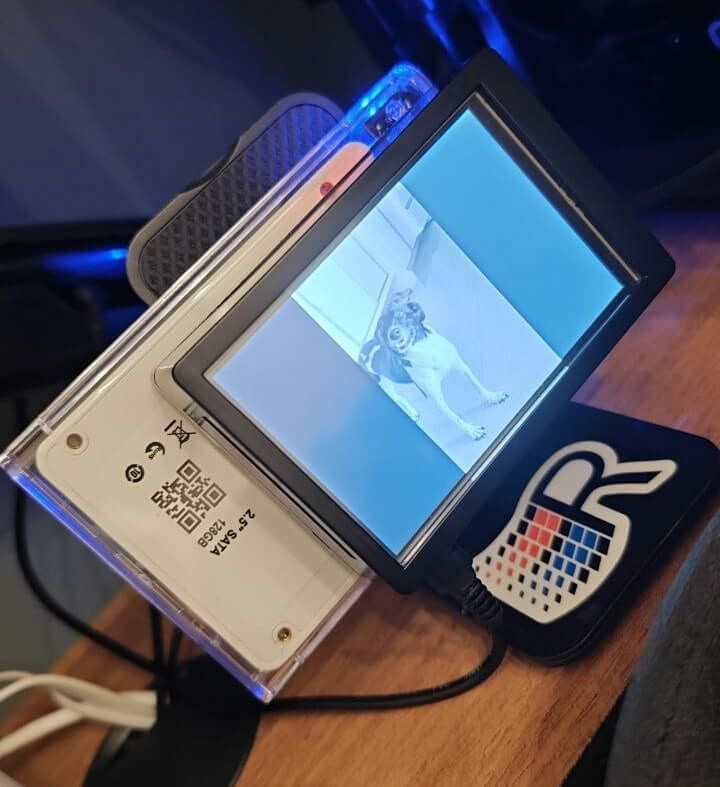
This blog follows the same logic, just at a smaller scale. It lives on my
domain, as a static build, without depending on a third-party platform to
exist. The posts are .mdx files straight in the repository; they don’t live
in any external service. Comments run on Giscus, which stores everything in
Discussions on a repository of mine,
so I don’t outsource even that part to a generic comment box.
There is one exception. I recently added a live chat to the blog using Firebase. It’s Google, it’s third party, it’s everything I just argued against. I added it anyway because it solved a real problem and I had no desire to run a WebSocket server just for that. Contradictory? Maybe. But it was a trade I made knowing the price.
The part about having fun
This is the part almost nobody talks about, but to me it weighs as much as the first one.
Doing things with personality is also a way of resisting a certain kind of standardization. The internet got full of sites that look like each other, because they came from the same template, the same design system, the same “safe” color palette. A weird site, one that looks like the person who made it, is a way of saying “this is me” on an internet that pushes everyone to look the same.
That’s basically what I described in Fun is the key. The things I grew the most with were almost always fun before they were productive. React95 is the clearest example. It became a whole Windows 95 interface for React because that was the way I found to learn design systems without getting bored in the process. It didn’t solve any direct business problem. It solved the problem of keeping me interested enough to learn.

And it went so far that, years later, I was extracting bitmap fonts from 1987
out of .FON files just because the font that “looked like” MS Sans Serif
wasn’t pixel perfect enough. Nobody needed
that. I wanted it right, not just similar.
Where they meet
Control without personality becomes just a server at home running generic services. Personality without control becomes a pretty profile on a platform that isn’t yours and can disappear tomorrow.
It’s the two things combined that make sense to me. A space that is mine, where I decide the infrastructure and I decide the face. The homelab keeps what’s mine. The blog publishes what I want, the way I want, with the right font if I feel like spending a weekend on that.
It’s not about following a list of protocols. It’s about not letting someone else decide how and where I exist on the internet.
Fun is the key, again. Only this time, applied to the internet itself.